
Can You Install Plantation Shutters on Sliding Doors?
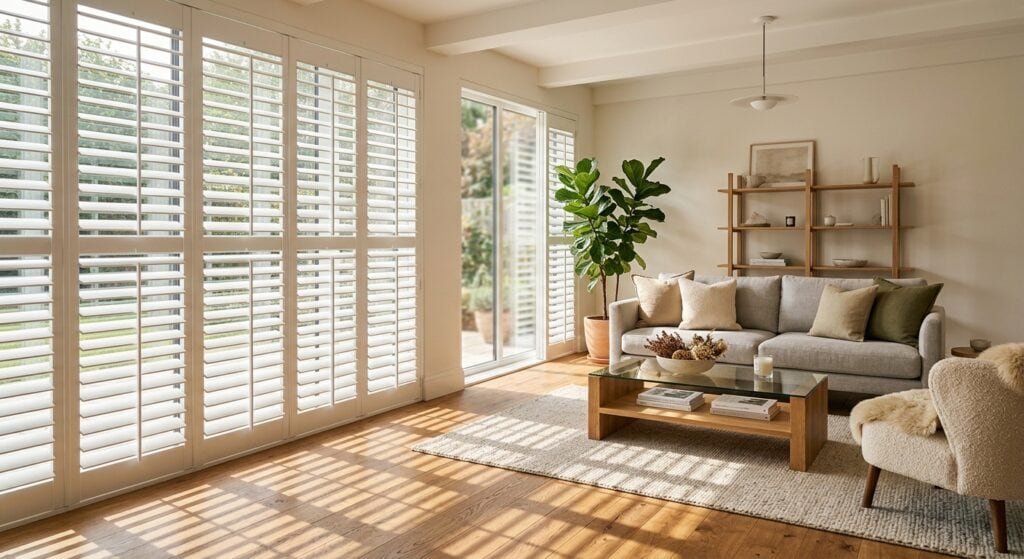
Yes, you can install plantation shutters on sliding glass doors, patio doors, and alfresco sliding entries. In Australian homes, sliding doors are a central architectural feature connecting indoor living spaces with decks, balconies, and backyards. Adding Plantation Shutters to these wide openings creates a clean, architectural finish while offering superior light control, privacy, and thermal insulation compared to traditional curtains or vertical blinds.
However, sliding doors present different engineering and operational challenges than standard windows. Because sliding doors function as high-traffic transit points, the shutters cannot simply be fixed directly into a standard window frame. Instead, they require specialised tracking systems and careful planning around door handles, stacking space, and everyday room flow. Understanding how different configurations operate is essential for achieving a practical and visually balanced result.
Tracked Shutter Systems for Sliding Glass Doors
Because sliding doors are often wide and tall, standard hinged shutter panels are generally unsuitable. Instead, custom sliding door shutters rely on dedicated top and bottom tracks that support the weight of the panels and guide their movement smoothly. The two primary tracking systems used are sliding bypass and bi-fold systems.
1. Sliding Bypass Shutter Systems
Sliding bypass shutters operate similarly to sliding glass doors. The shutter panels are hung from an overhead track with multiple channels, allowing the panels to slide smoothly past one another horizontally.
- Closed-track bypass: In this configuration, panels run on separate tracks. You can slide one panel behind or in front of the other to access the door handle or step outside. Louvers may need to be closed before sliding the panels across one another, depending on track depth.
- Open-track bypass: Designed with wider track spacing so that the shutter louvers can remain open or tilted while the panels slide past each other. This setup provides continuous airflow and light management without needing to close the slats every time you slide a panel.
Bypass shutters are ideal for rooms where space is at a premium, as the panels remain completely within their dedicated track line and do not swing out into the living area or patio.
2. Bi-Fold Tracked Shutter Systems
Bi-fold shutters feature panels hinged together in pairs and suspended from a heavy-duty top track. When opened, the panels fold concertina-style and slide to one or both sides of the door opening.
- Full opening access: When bi-fold shutters are stacked against the wall, they expose almost the entire width of the glass, maximising your view and creating an unobstructed pathway between indoors and outdoors.
- Flexible positioning: You can choose to fold just one pair of panels back for quick door access, or fold the entire set back when entertaining or airing out the house.
Bi-fold shutters require more floor and wall clearance than bypass models because the panels project out into the room as they fold.
Crucial Considerations Before Ordering Shutters for Sliding Doors
Every home layout is unique, and choosing the right setup requires evaluating how your household interacts with the space daily. Explore our wider range of plantation shutters to see how different materials and configurations perform across various living zones.
Traffic Flow and Daily Usage
Consider how frequently the sliding door is opened. If the door serves as your main entry point to a busy outdoor dining area or backyard, you need quick, effortless access. A bypass system aligned with the sliding glass door lets you slide open a single panel just like opening the glass door itself. If the door is rarely used and primarily acts as a light source, a bi-fold system can provide a dramatic aesthetic with wide-open views when desired.
Handle and Screen Clearances
Sliding door handles, security screens, and flyscreen tracks often project beyond the standard door frame. Shutter tracks must be mounted with sufficient clearance so that the shutter blades do not strike door handles, locks, or frame extrusions when opening, closing, or tilting. In many cases, custom build-out frames or pelmets are installed to position the track safely in front of existing door hardware.
Stacking Space and Room Layout
When bi-fold panels fold together, they create a “stack” on one or both sides of the opening. If you have adjacent walls, light switches, power outlets, or nearby structural columns, ensure the stacked panels do not block walkways or cover important controls. If your door is surrounded by solid wall space, bi-fold systems can sometimes be configured to fold flat against the adjacent drywall, keeping the glass completely clear.
Furniture Proximity
Because bi-fold panels swing outward as they fold, they require a clear arc of movement. Dining tables, sofas, floor lamps, and side tables must be placed far enough away to avoid obstructing the folding path. If your room layout requires furniture to sit close to the sliding door, a sliding bypass track is generally the more functional choice.
Why Choose Plantation Shutters for Sliding Doors?
Installing custom shutters on sliding doors provides several practical advantages over soft fabric coverings:
- Precise Light and Glare Control: Tilt the louvers to direct harsh morning or afternoon sunlight upward toward the ceiling, illuminating the room while eliminating direct glare on screens and furniture.
- Enhanced Privacy Without Darkness: Keep the lower or upper louvers angled to block sightlines from neighbours while still welcoming natural daylight and breeze.
- Thermal Insulation: Quality shutter panels create a solid barrier against radiant heat transfer during hot summer days and help retain warmth indoors during cooler winter nights.
- Durability and Cleanliness: Unlike vertical drapes that can sway, tangle, or collect dust in high-traffic doorways, tracked shutter panels remain rigid, stable, and easy to wipe clean.
Frequently Asked Questions
What type of shutters work on sliding doors?
Tracked bypass shutters and tracked bi-fold shutters are the two most effective styles for sliding doors. Bypass systems feature panels that slide horizontally across multi-channel tracks, whereas bi-fold systems use hinged panels that fold together against the side of the opening.
Do plantation shutters slide out of the way?
Yes. Both bypass and bi-fold systems are engineered to slide along overhead tracks. Bypass panels slide left or right within their track lanes, while bi-fold panels fold together and slide neatly to the edges of the opening, allowing full access to the doorway.
How much space do tracked shutters need?
The space required depends on the tracking system and the depth of the shutter louvers. Bypass tracks usually require around 130 mm to 180 mm of depth to allow panels to slide past one another and clear door handles. Bi-fold systems need less track depth (typically 70 mm to 100 mm) but require clear floor and room space equal to the width of a single panel to allow the concertina folding action.
Can shutters cover large glass doors?
Yes. Custom tracked plantation shutter systems can span wide multi-panel sliding doors, corner sliders, and wide alfresco openings. Multiple tracks and panel combinations are calculated by professional installers to ensure structural stability and smooth, long-term operation across large spans.
Are plantation shutters practical for frequently used doors?
Yes, provided the configuration matches the way the door is used. A bypass system designed with panels that match the layout of the glass doors allows you to slide one shutter panel across for immediate passage, making it just as quick and convenient as opening the sliding door itself.